
🦎 The Secret Life of Baja’s Tiny Desert Lizards: Nature’s Hidden Gems in Los Cabos
Hello, dear traveler! I’m Walter Kayser, your local concierge here at LosCabosHub.com. When visitors come to Cabo, most expect sun, sea, and sand. But I want to introduce you to a different kind of wonder — the small, quick, and often invisible lizards that thrive in Baja’s desert. If you pay attention, you’ll see nature’s hidden gems dancing on rocks, hiding in cacti, and making the wilderness come alive. Image - Wikipedia
ECOTOURISMNATURE
5/8/20242 min read

🦎 Why Desert Lizards Matter (Even When You Don’t Notice Them)
Desert lizards are key to ecological balance: they eat insects and in turn become prey to birds and snakes.
They are indicators of habitat health — if lizard populations decline, it’s often a red flag for environmental stress (pollution, habitat loss).
Their camouflage, color changes, and behaviors are fascinating adaptations to extreme heat and sparse water.
📍 Species You Can Find Around Los Cabos
Here are a few species you might spot near San José del Cabo or on desert hikes:
Common Name Scientific Name Brief Traits
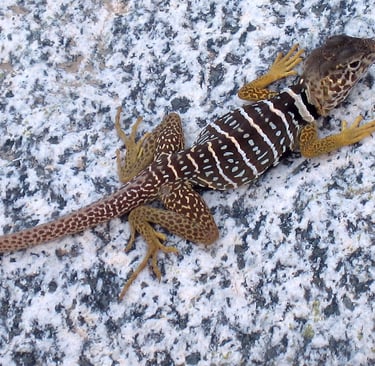
Collared Lizard Crotaphytus bicinctores Bold stripes, often sunning on rocks.
Zebra-tailed Lizard Callisaurus draconoides Tail looks like zebra stripes, runs with tail waving.
Spiny Whiptail Aspidoscelis spp. Slender, fast-moving; often in shrubland.
Chuckwalla Sauromalus spp. Larger, plump lizard that hides in rock crevices
when hot.
(Note: Exact species distributions vary; I verify with local field guides and experts when possible.)
One remarkable fact: zebra-tailed lizards can run on their hind legs when startled, lifting their front legs off the ground for brief sprints.
🌡️ How They Survive Baja’s Harsh Climate
In the blazing midday sun, many lizards stay hidden under rocks or in burrows. During early morning and late afternoon, they emerge to bask, feed, and mate. Their skin reflects sun, and some change tone slightly to regulate body temperature.
On hot days, you may see them panting (yes, like dogs!) or lying flat to let more surface touch the ground to dissipate heat.
🔍 Where (and How) to Spot Them
Rocky slopes and hillsides just outside urban edges — walk quietly early morning.
Among cacti and shrubs in desert patches (e.g. near desert trails).
Around agave or mesquite bushes, where shade meets sun.
On cool shady walls of abandoned structures — this is where they sometimes rest.
Tips:
Move slowly; sudden motions scare them off.
Use binoculars or zoom camera; no need to approach.
Wear light, neutral clothing that blends into desert hues.
🌟 About This Article
At LosCabosHub, we believe true travel isn’t just seeing the obvious — it’s noticing what others don’t. This article shows:
We go deeper than superficial attractions.
We share real, verifiable knowledge about Cabo’s ecology.
You’ll see our passion and authenticity, not just marketing.
We care about small desert lizards, you can trust we’ll care about your experience, safety, discounts, and local secrets.
📞 Let Me Help You Explore It All
Whenever an article piques your curiosity and you want to turn it into plans, just reach out. I’m here via WhatsApp or email to help book tours, give location tips, or design a lizard-watching walk for your trip.
Behind me in this venture is Nallely Martínez, the organizational heart of Los Cabos Hub — she makes sure everything works behind the scenes so you get flawless service.
So whether you’re here for beaches or for desert wonders, I’ve got your back. Let’s explore the hidden, the delicate, the magical — together.
— Walter Kayser
CONTACT US
loscaboshub@gmail.com
Phone: +52 624-518-6010
© 2025. All rights reserved.